Oct 6, 2025
𝄪
Research
𝄪
5 min to read
Is Tech the Real Bubble, or Is Everything Else?
Why the 2025 AI Boom Looks Nothing Like the Dot-Com Era
Why the 2025 AI Boom Looks Nothing Like the Dot-Com Era
When you see headlines claiming that tech investment accounts for "almost all" of US economic growth, your first instinct might be to reach for the panic button. After all, we've been here before—right? The year 2000 taught us what happens when tech valuations disconnect from reality.
But here's the twist: this time might actually be different. And not in the way you think.
The Numbers That Started the Conversation
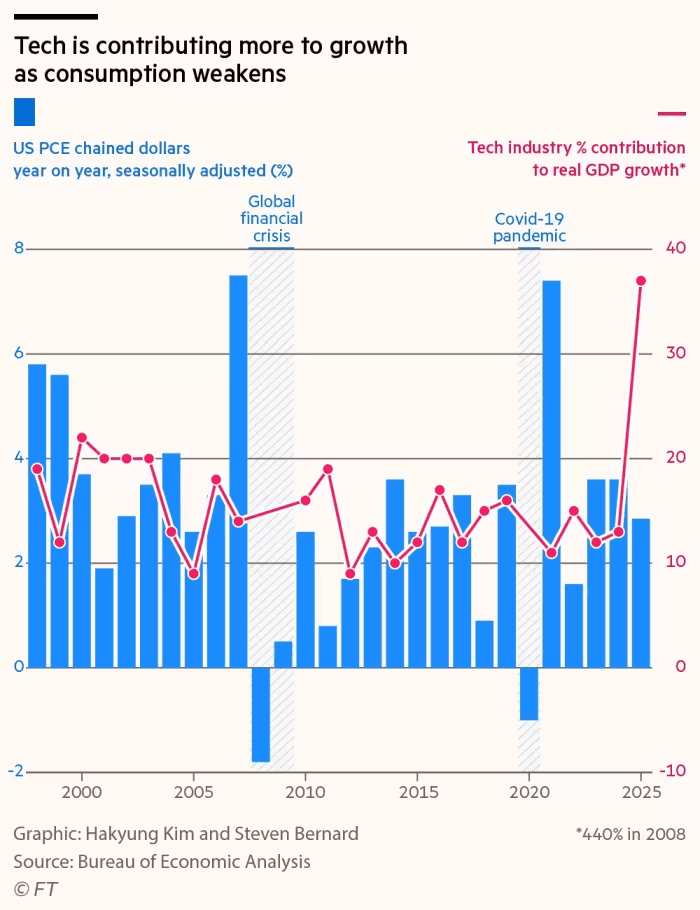
According to recent analysis from the Financial Times, tech's contribution to real GDP growth has spiked to over one-third this year—a dramatic increase from the historical baseline of 10-20%. At first glance, this looks like a massive red flag. Tech dominance at these levels seems unsustainable, almost bubble-like.
But when you dig deeper into what's actually happening in the economy, a more nuanced picture emerges.
The Denominator Problem
Here's what makes 2025 fundamentally different from previous tech booms: tech isn't just growing faster—everything else is growing much slower.
Personal consumption expenditures (PCE), typically the largest component of GDP, have weakened significantly compared to historical norms. This creates what I call the "denominator problem." Tech's share of GDP growth looks astronomical partly because:
The numerator is strong: AI infrastructure investment is genuinely massive
The denominator is weak: Total GDP isn't growing robustly
Tech is gaining ground both because it's legitimately strong and because consumer spending and other sectors are underperforming. This makes tech's surge look more dramatic than it might be in a healthier, more balanced economy.
Not Your Father's Bubble
This is where the comparison to 2000 gets interesting—and ultimately breaks down.
During the dot-com era, tech equity valuations soared to dizzying heights while contributing relatively little to actual economic output. The disconnect between market value and economic impact was the bubble. Companies with no revenue commanded billion-dollar valuations based on pure speculation.
Today, the relationship is inverted:
Tech's market valuations match its substantial, real contribution to GDP growth
The investment in AI infrastructure represents tangible capital expenditure with measurable economic impact
Tech companies are generating actual revenue and profits at scale
The valuations are more justified now than they were then. That's crucial.
The Uncomfortable Hypothesis
So if tech isn't the bubble, what is?
Here's the contrarian take: non-tech sectors might be the truly overvalued assets in today's market.
Think about it. When market indices remain resilient despite weak fundamentals in consumer-facing sectors, those sectors are essentially riding tech's coattails. They're enjoying a "halo effect"—looking safer and more stable than their underlying performance justifies, simply because tech's strength props up the broader market.
This creates a hidden risk. If the AI investment cycle cools and other sectors don't pick up the slack, we could see substantial de-rating across the market. But the pain would be concentrated not in tech—where economic contribution validates valuations—but in the sectors whose valuations have been artificially supported by market resilience driven primarily by tech.
What This Means for Investors
The implications are significant:
Watch the denominator, not just the numerator. Tech's GDP share is elevated partly due to relative underperformance elsewhere. The real question isn't whether tech can maintain its blistering pace—it's whether other sectors can resume meaningful growth.
Monitor consumption closely. If consumer spending remains weak while tech investment eventually normalizes, the underlying fragility of the market could become apparent. Record-low PCE is masking how dependent the entire market has become on a single sector's performance.
Question the baseline. When you see broad market strength, ask yourself: is this reflecting healthy, diversified growth, or is it tech carrying the team? Sectors that appear stable might be more vulnerable than they look.
The Bottom Line
We're not in a tech bubble. We're in something potentially more concerning: a market where one sector's genuine strength has created the illusion of broad-based health, while other sectors remain fundamentally weak but appear stable due to overall index resilience.
The 2025 AI boom is real, justified, and backed by actual economic contribution. But that doesn't mean the market as a whole is healthy. In fact, tech's dominance might be hiding a more uncomfortable truth: if tech's momentum fades before the rest of the economy strengthens, we may discover that the real overvaluation was never in tech at all.
It was everywhere else.
The key difference between wisdom and intelligence is knowing which questions to ask. In 2000, we asked "Is tech overvalued?" In 2025, perhaps we should be asking: "What's holding up everything that isn't tech?"
FOOTNOTE